FORCEMAP
Scaling training data for physical AI, using a sensor-fusing wearable
Co-founder · CTO
Robots learn to manipulate objects from human demonstrations, but video only shows where your fingers are, not how hard they're pressing. Together with Kevin Paul and Madhav Lodha, I co-founded FORCEMAP to fix that. We're currently developing a forearm band that estimates per-finger force from the muscles and tendons in your arm, so your hands stay bare. I'm currently in charge of the hardware stack, while the others take care of ML/modelling and deployment. Our first prototype took one week to build and already tracks force live at r = 0.76, and v1 is in design right now.
The problem, in two photos
The problem we're solving is shown in the two photos below. While other startups have been very successful at scaling egocentric video, force data simply cannot be estimated from vision alone. By rapidly deploying our sensor-fusing wearable, scaling hybrid datasets becomes a possibility.
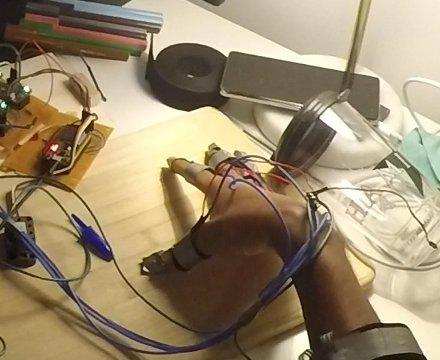
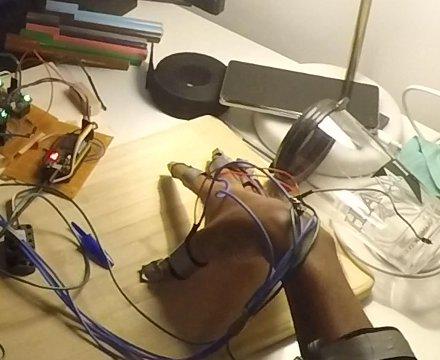
In our v0 prototype, we used an array of basic FSRs mounted on a wristband to estimate force at the fingertips (shown above). When your fingers press, the muscles and tendons in your forearm fire and change shape. A band around the forearm can pick that up, and with a model, we can map it back to the force on each finger.
v0: a band in a week
For the first prototype, speed mattered a lot more than looks, so it was deliberately ugly. Eight force-sensitive resistors sit in pods around a strap and press into the forearm. They're read by four 16-bit ADS1115 ADCs on protoboards, with an ESP32 streaming everything over USB at 50 Hz. Every time you put it on, it needs about ten minutes of calibration.
For ground truth, we used fingertip force sensors, calibrated using a load cell. The wearer presses with each finger, first lightly and then firmly, while both streams are recorded. A model then learns the mapping from the band readings to the force on each finger.
the band, v0 vs v1
| Force sensing | 32 pressure taxels (8 pods × 4) |
| Muscle activity | 8-ch dry EMG |
| Motion | IMU |
| Sample rate | 100 Hz · EMG at 1 kHz |
| Link | Bluetooth LE |
| Calibration | none (target) |
| Brains | nRF5340 · ADS1298 + ADS131M08 · one 6-layer board |
EMG electrodes and pressure taxels side by side on every pod, all touching the skin.
Does it work?
The plot below is a real live take that the model never saw during training. The white line is what the fingertip sensors measured, and the red line is what the model predicted from the forearm band alone. The cue box shows what's currently being tested.
Replayed from the recorded take: 25 Hz, ~100 s, tested on thumb, index, middle and ring finger.
Preliminary results are promising but not perfect. v0 clearly tracks the force, light vs firm is obvious and the timing is tight. Separating the individual fingers is the hard part though, and light touches are where FSRs struggle the most. Pressure alone mostly tells you that something is happening in the forearm, not exactly which finger is doing it.
That's what v1 is for.
v1: Sensor Fusion & Pilot
For v1, we're replacing the protoboards with a custom 6-layer PCB built around an nRF5340, making the band completely wireless. We're aiming for 16 sensor tiles around the arm, each with 4 pressure taxels and 2 dry EMG electrodes side by side. The strap stretches, with serpentine flex running inside it, and an indexed clasp makes sure the tension is the same every time you put it on.
- ADS1298 for 8 channels of EMG at 1 kHz. Muscle activity shows up before the force does, and EMG is much better at picking up light touches.
- ADS131M08 for the 32 pressure taxels at 100 Hz.
- An IMU for arm motion.
- A hub with a sync LED (for lining up with video), a button, charge pads and a 500 mAh LiPo.
The end goal is a wireless wearable system that doesn't require calibration, enabling force data collection at unprecedented scale.
We're starting with factories, then households. If you're training manipulation models and need force labels, feel free to reach out!