Physics Research
Research assistant at UNSW Condensed Matter Physics Group: magnetometry, neutron scattering and crystal-field modelling
Research assistant · A/Prof Clemens Ulrich, UNSW
Physics has always been one of my favourite subjects. After completing the initial taste of research program, I permanently joined UNSW's condensed matter physics group as a research assistant for A/Prof Clemens Ulrich. My first project used SQUID magnetometry on the frustrated magnet YBaCo₃FeO₇ (the full report is linked above). I have since participated in a neutron scattering beamtime at ANSTO Nuclear Facility, and currently work on modelling crystal fields and magnetic excitations in rare-earth perovskites with various international collaborators.
Frustrated magnets
My first project was on YBaCo₃FeO₇, a kagome magnet where the geometry of the crystal stops the spins from settling into an ordered state, which makes it a candidate spin liquid. Using the group's SQUID magnetometer, I extended previous measurements to fields of ±7 T and temperatures down to 2 K, in three crystal orientations. The main result was a small magnetic hysteresis below about 50 K, which hints that there's more going on than geometric frustration alone. The details are in the report linked at the top of this page.
zoom into the result
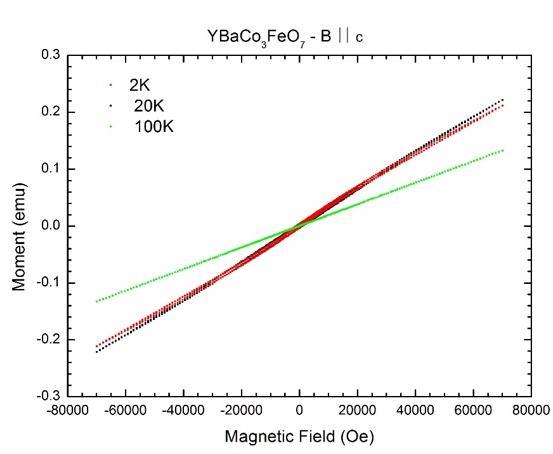
Full sweep, ±70 000 Oe
Field ramped up to +7 T, down to −7 T and back, about three hours per loop. At this scale it just looks like a straight line. If there's a hysteresis, it's tiny.
Crystal fields and neutron scattering
In November 2025, I joined a beamtime at ANSTO's OPAL reactor, using neutron scattering to study skyrmion dynamics in Cu₂OSeO₃ and helping with X-ray sample alignment.
Since then, most of my work has been analytical. In rare-earth compounds, the electric field of the surrounding ions (the crystal field) splits the energy levels of the rare-earth ion, and inelastic neutron scattering can measure those splittings directly. I'm currently working on rare-earth perovskites, where these crystal-field levels also interact with the magnetic order of the rest of the lattice. Leveraging my background in CS, I have mostly worked on the modelling:
- Crystal-field fitting: a Python pipeline that fits Stevens-operator Hamiltonians directly to the measured spectra, including thermal populations and internal magnetic fields, with bootstrapped uncertainties. It was validated against the established McPhase code.
- Point-charge modelling: estimating the crystal-field parameters from the positions of the surrounding ions, which gives the fits a physically motivated starting point.
- Spin waves: fitting linear spin-wave models to the measured magnon dispersions, and looking at how magnons and crystal-field levels hybridise.
Since results are pending publication, I'm unable to share data for the more recent projects at this moment.